

Sarudo Web Analysis shows what makes a web page hard to use, and how to fix it. Click it on any website for a score out of 100, a letter grade from A to F, and the top problems first, each with a concrete fix.
It isn't in the Chrome Web Store yet, so you add it to Chrome yourself: download both files, then follow the setup steps below.
You need both parts.
The button in Chrome's toolbar and the report you see.
sarudo-web-analysis-1.0.0.zip · 154 KB
A small program that works out the grade, on your own computer. You install it once.
sarudo-web-analysis-server-1.0.0.zip · 17 KB
Jakob Nielsen's 10 usability heuristics are widely used rules of thumb for making websites easy to use. Sarudo Web Analysis checks the page against them, from what's actually on it.
Every problem costs points depending on how serious it is. A critical one, such as a pop-up you can't close, sound that plays by itself or a form where most fields have no label, holds the grade at C or below until it's fixed.
The most important problems come first, each marked Critical, Major, Minor or Cosmetic, with a concrete change to make.
A score out of 10 for each of the 10 heuristics, the facts it measured and what to change. N/A means a heuristic doesn't apply, such as form checks on a page with no form.
Home page, product page, checkout, article: checks that don't fit the page are skipped. If it guesses wrong, pick the right type and the grade updates.
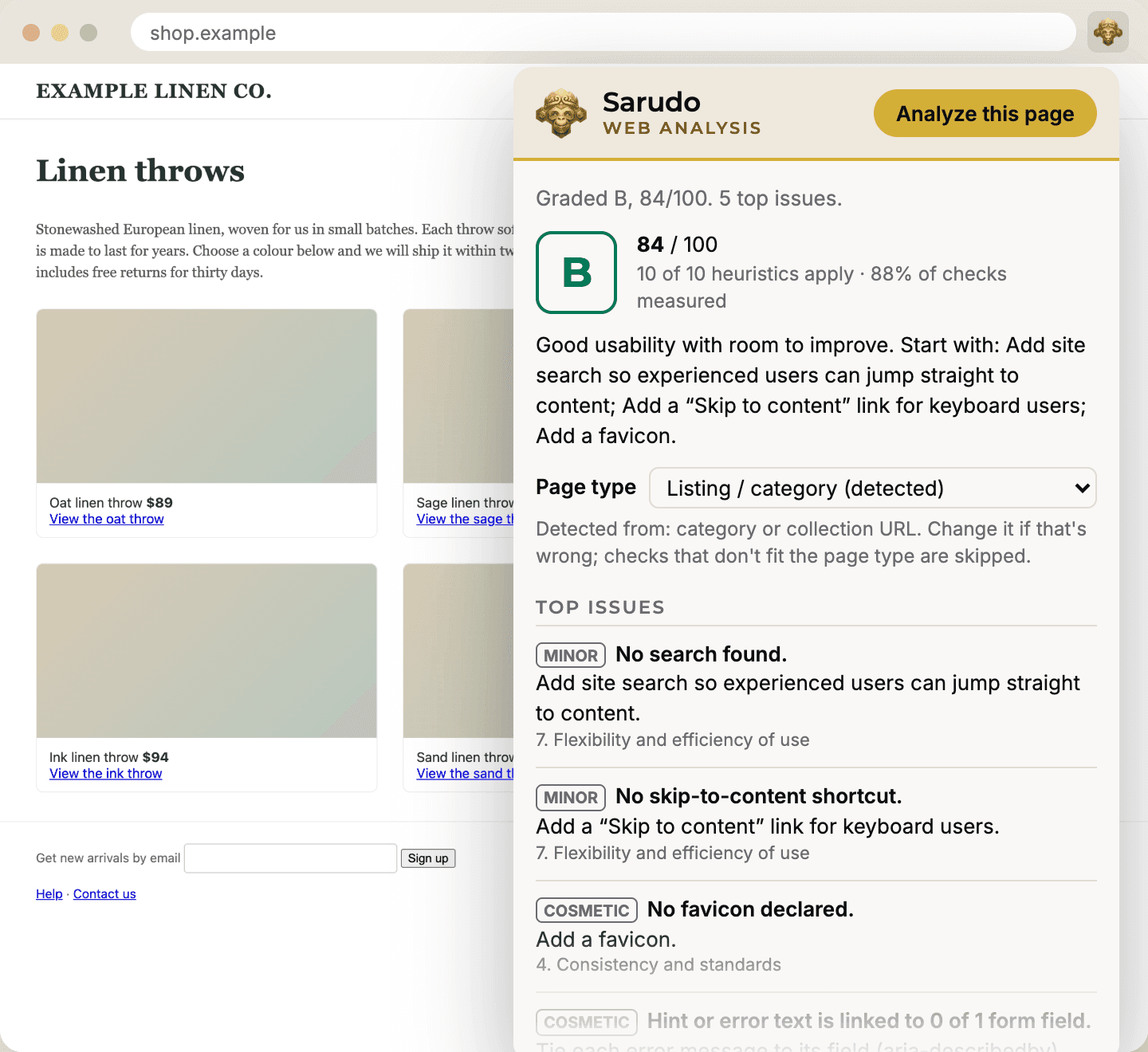
It reads the page as loaded, so it can't judge visual design, how the site behaves as you click through it, or content inside frames from other sites, such as payment boxes and cookie banners. PDFs, images and near-empty pages are marked Not graded instead of getting a misleading grade. Use the grade as a guide for a UX review, not a replacement for one.
It reads a page only when you click Analyze this page. It works out counts and yes/no facts in your browser, such as “12 links, 1 form field without a label”, and sends only those, plus the page's language and the kind of page it detected, to the scoring server on your own computer. It never sends the page's address, title or text. Nothing is stored, and nothing leaves your computer.
On macOS, Windows or Linux. ChromeOS isn't supported, because the server can't run there.
It's free. Step 1 below shows how to check for it and install it if you need to.
The installer downloads the server's parts. After that it works offline.
Install the scoring server first, then add the extension to Chrome. Commands go in Terminal on a Mac or Linux, or PowerShell on Windows. Copy one with the button beside it, or click it once to select all of it and press ⌘ C or Ctrl + C.
On a Mac, open Terminal (press ⌘ Space, type Terminal, press Enter). On Linux, open a terminal. Then type:
python3 --versionOn Windows, open PowerShell (press the Windows key, type PowerShell, press Enter) and type this instead:
py --versionIf it says Python 3.10 or higher, go to step 2. If it's older, or the command isn't found, install it. It's free.
sudo apt install python3 python3-venv on Ubuntu.Download the server, zip file, 17 KB and unzip it (on a Mac, double-clicking the zip does that). You'll get a folder called sarudo-web-analysis-server-1.0.0 in your Downloads.
In Terminal, paste this line and press Enter:
cd ~/Downloads/sarudo-web-analysis-server-1.0.0 && bash install.shIt takes about half a minute and installs into a hidden folder in your home folder, ~/.sarudo-web-analysis.
cd ~/Downloads/sarudo-web-analysis-server-1.0.0 && bash install.sh --no-autostartbash ~/.sarudo-web-analysis/uninstall.sh to remove the login item.Open the unzipped folder (the one with server.py inside) in File Explorer, then Shift + right-click inside it and choose Open PowerShell window here. Run this once:
py -3 -m venv .venv; .venv\Scripts\pip install -r requirements.txtThen start the server from the same folder, now and each time you want to use the extension, and leave the window open:
.venv\Scripts\python server.pycd ~/Downloads && unzip sarudo-web-analysis-1.0.0.zip -d sarudo-web-analysis-1.0.0sarudo-web-analysis-1.0.0 with manifest.json directly inside.chrome://extensionssarudo-web-analysis-1.0.0 folder.Leave Developer mode on: recent versions of Chrome switch off extensions added this way when it's off.
Click the puzzle-piece icon in Chrome's toolbar, then the pin next to Sarudo Web Analysis. Its button, a gold monkey face, now stays in the toolbar.
A setup page opens by itself when you add the extension. Within a couple of seconds its status turns green: ✓ The server is running. You're all set.
If it says the server isn't running yet: on a Mac, run the install command from step 2 again; on Windows or Linux, start the server (step 2) and leave its window open.
If the server isn't running later on, the extension says so when you press Analyze this page, with a Set up the local server → link that reopens the setup page.
You'll see the grade and score, the top issues and how to fix them, the kind of page it detected and a score for each heuristic. The report disappears when you close it; nothing is kept.
bash ~/.sarudo-web-analysis/uninstall.shchrome://extensions and click Remove on Sarudo Web Analysis. You can then delete its folder too.What the extension or the installer may tell you, and what to do about it.
cd commandcd and a space, drag the unzipped folder onto the Terminal window, press Enter, then run bash install.sh.http:// or https://, and try again.manifest.json directly inside it.chrome://extensions and click the ↻ reload arrow on Sarudo Web Analysis.chrome://extensionsTo check the server by hand, open http://localhost:8420/health in Chrome. If it shows {"status":"ok",…}, the server is running.
Write to support@sarudo.com. Say which step you're on and what you see.
Sarudo Web Analysis is an independent tool by Sarudo. It isn't affiliated with or endorsed by Nielsen Norman Group.